A self-employed endeavor...

Being so blessed by God, the Almighty three-in-one creator, to share Jesus (Yeshua), the Christ (Messiah), prayerfully, this blog is a self-employed effort for God's glory, aim to bless, challenge, and encourage readers of these posts to share Jesus, the way, the truth, and life. Only should the Lord so lead, readers can support this endeavor by clicking PayPal. Thank you.

Today's Bible Verse

Sunday, March 1, 2020

Trusting God Through Desperate Times

Continued from NOW IS THE TIME. This post focuses on, Scripturally, Genesis 19:30-38; Matthew 9:18-38; and historically, missionary William Carey.

Lot has left the city of Zoar because he feared the people there. We find him now living in the mountains, along with his two daughters.

The daughters suddenly realize their situation and get desperate. “Hey,” the older says to her younger sister, “There are no men around here – anywhere – for us to marry so we can have children to preserve our family line!”

A worrying concern wrinkles the women’s brows. In extreme anxiety, the older sister proposes an idea to the younger; she agrees.

On consecutive nights the daughters of Lot get their father drunk with wine. The first night the older daughter sleeps with her father. The younger sister does the same the next night.


Each sister, pregnant by her father, bears a son. The older sister gives birth to Moab, father of the
Moab mountain range viewed
from 
Jordan Valley
 Moabites. The younger gives birth to Ben-Ammi, father of the Ammonites.
Ammon and its neighbors,
around 830 BC
[citation needed]

Two nations, products of incest, become Israel’s greatest enemies, whom Israel never defeats. Yet, despite the sinful act by the desperate daughters of Lot, the blessing of Abraham for all ‘nations’ (peoples) is not defeated: From Moab comes Ruth, the great-grandmother of Israel’s great king David. From David ultimately comes Jesus (Yeshua), God’s Son, who displayed such great love for all ‘nations’ (peoples) despite their sin.


God is concerned for much more than the physical. His greatest concern is for the desperate condition of fallen humanity (broken fellowship) – desiring much more to restore the relationship between Him and mankind.


We zoom centuries ahead in time to the New Testament era, and see Jesus (Yeshua) confronting desperate people:

A leader of a synagogue whose little girl has died; yet, he believes that Jesus can bring the child to life again.

A woman who has suffered from a hemorrhage (constant bleeding) for twelve years; but still, she believes, “If I can touch [the fringe of] his robe, I will be healed."

Two blind men who believe Jesus can give them sight.

A demon-possessed man who is brought to Jesus; Jesus casts out the demon, to the amazement of the crowd (yet to the scorn of the Pharisees – not all people will see a miracle as a blessing from God).

Indeed, Jesus meets them all in their desperation – their distress – healing their physical infirmities. He, the same “yesterday, today, and forever” (Hebrews 13:8), is able to meet us in our desperate circumstances as well, whatever they may be.

However, Jesus is concerned for much more than the physical. His compassion is for the restoration of fallen humanity (broken fellowship) to a right relationship, a "holy love affair," with the Holy Trinity – Father, Son, and Holy Spirit. This is Jesus as He sees the crowds (of His day and ours) “confused and helpless, like sheep without a shepherd” (Matthew 9:36).


Once again zooming ahead – to Northampton, England. Born here in 1761 is William Carey (see


Ruth A. Tucker: From Jerusalem to Irian Jaya). He, too, is to become a man who has to trust God through desperate times – through struggles and distressing circumstances.

Son of a weaver, Carey works on a loom in his family quarters. Problems with allergies prevent him from pursuing his dream of becoming a gardener. At 16 years of age, he is apprenticed to a shoemaker. Through the witness of another apprentice, he is converted to Christianity, and actively associates himself with the Baptist Dissenters. He devotes his leisure time to Bible study and lay ministries.

Before the age of 20, Carey marries his master’s sister-in-law, Dorothy. She is more than five years older than he and illiterate. A “mismatched marriage,” as Tucker puts it, is met with hardship and poverty. Carey nevertheless continues his studies and lay preaching, pastoring two small Baptist churches while continuing to make shoes.

Carey reads Jonathan Edwards account on the life of David Brainerd and the journals of explorer James Cook. His heart is stirred toward the biblical mandate of spreading the Good News of Jesus Christ throughout the world. Yet, even while he is presenting this idea before a group of ministers, it is rejected. “Sit down,” they respond. “When God pleases to convert the heathen, He will do it without your aid or mine.”

Undaunted, Carey continues presenting his case for worldwide missions, challenging audiences from Isaiah 54:2-3, he challenges them with his now-famous quote, “Expect great things from God; attempt great things for God.”

Eventually, with the formation of the Baptist MissionarySociety, Carey offers himself for missionary service. In March of 1793, he sails for India, accompanying the Society’s first appointee, John Thomas, and Thomas’ wife and daughter. Carey’s eight-year-old son, Felix, journeys with them.

In India William Carey faithfully pursues the task that God had “planned for [him].” And He does so for all who put their trust in Him. As the apostle, Paul has written: “For we are God’s masterpiece. He has created us anew in Christ Jesus so we can do the good things he planned for us long ago [even through desperate times – struggles and distressing circumstances]”  (Ephesians 2:10; cf. 2 Corinthians 6:4.)

“[Jesus] said to his disciples, ‘the harvest is great, but the workers are few. So pray to the Lord who is in charge of the harvest [and who delights in our participation with Him in His cause for the peoples of the world]; ask him to send more workers into his fields.’”
(Matthew 9:36-38.)


Coming next month Trusting Through Weakness...

Saturday, February 1, 2020

Now Is The Time

In the evening the two men (angels sent from God) arrive in Sodom. [See previous day, His Call Keeps Ringing.] Lot is sitting in the gateway (the entrance) of the city. Welcoming the men, Lot invites them to come to his house as his guests.

“Oh no,” they reply. “We’ll just spend the night out here in the city square” (Genesis 19:2.)

But the two men yield to Lot's insistence and go with him to his house, where Lot prepares for them a feast.

Shortly before they settle down for the night, a noisy clamor rises outside. Stepping outside, Lot notices the men of Sodom surrounding the house.

“Where are the men who came to spend the night with you?” they shout. “Bring them out to us so we can have sex with them!” (Genesis 19:5.)

“Please, my brothers,” Lot begs, “don’t do such a wicked thing. Look, I have two virgin daughters. Let me bring them out to you, and you can do with them as you wish…” (Genesis 19:7, 8.)

But the men of Sodom won't hear it. Pressing hard against Lot, they attempt to break down the door. Lot's guests pull Lot back inside the house and strike the men of Sodom with blindness. Wearily, they stumble about trying to find the door.

The next morning, having heeded the angels' warning, Lot, his wife, and his two daughters flee Sodom, escaping to the city of Zoar – the angels having granted Lot’s request to spare that little village(Genesis 19:21.)

(A thought to ponder: For the righteous remnant, the LORD is merciful.)

The Destruction of Sodom and GomorrahJohn Martin, 1852
In Zoar, Lot and his family find refuge from the fire and brimstone the LORD rains on Sodom and Gomorrah“He utterly destroyed them, along with the other cities and villages of the plain...”  (Genesis 19:25.)

“But Lot’s wife looked back [to where she had come from], and she turned into a pillar of salt” (Genesis 19:26; cf.  Luke 17:31-33.)


Rising early, Abraham “hurried out to the place where he had stood in the Lord’s presence.” Looking toward those cities of the plain he saw the smoke ascending “like smoke from a furnace.” (Genesis 19:27, 28.) Granting Abraham’s request (See Genesis 18:23-32), the LORD “kept Lot safe, removing him from the disaster that engulfed the cities on the plain” (Genesis 19:29.)


We now flash ahead through time to the New Testament era, just in time to hear Jesus answering the Pharisees' question, “When will the Kingdom of God come?”

“The Kingdom of God can’t be detected by visible signs,” Jesus answers. “For the Kingdom of God is already among you” (Luke 17:20-21).

(“The kingdom of God is not like an earthly kingdom with geographical boundaries,” as noted in the Life Application Study Bible – LASB. “Instead, it begins with the work of God's Spirit in people's lives...”)


Later, with His disciples, Jesus speaks again of this, and of His return.

It will happen quickly – when we least expect it. And many will not be aware of it. For as in the days of Noah, many will be buying, selling, planting – going about their earthly business and pleasure as usualAs in the days of Noah, when he entered the ark, the flood came and destroyed them all. And when Lot went out from Sodom “…fire and burning sulfur rained down from heaven and destroyed them all” (Luke 17:29).

Jesus concludes with a warning, as the LASB notes, “against false security. We are to abandon the values and attachments of this world to be ready, for Christ's return...” seeking first Christ's Kingdom on earth, (See Matthew 6:33.) in peoples’ lives.

“Remember what happened to Lot’s wife!” Jesus declares, “If you cling to your life, you will lose it, and if you let your life go [for the cause of Christ], you will save it” (Luke 17:32, 33).


We zoom ahead once again in time, to the closing days of the 19th Century. We arrive in China to find Jonathan and Rosalind Goforth fleeing for their lives, escaping the ravages of the Boxer Rebellion– in brief, according to Wikipedia.org, “a … movement by the 'Righteous Harmony Society' … opposing foreign imperialism and Christianity...”

Jonathan Goforth
Born in western Ontario, Canada, in 1859 Jonathan Goforth had given his life to the cause of Christ after reading the Memoirs of Robert Murray M’Cheyne. Then, hearing a missionary powerfully appealing for workers in China, Goforth had sensed his call to missions.

“As I listened to these words,” Goforth would later say, “I was overwhelmed with shame…. From that hour I became a missionary.”


Graduating from Knox College, Goforth had worked for a while in city missions in Toronto where he had met Rosalind Smith, who later had become his wife.

Rosalind Goforth
Presbyterian students from Knox College had raised funds, and the Goforths had set sail for China in 1888. Answering the call, the Goforths had labored for Christ’s Kingdom in China’s Honan province, sharing their eternal hope with the Chinese via “open-house” evangelism.

That is to say, the European interior design of the Goforth’s home had aroused the curiosity of the Chinese, who all wanted to see it. Before giving a tour of the house, however, Jonathan would share the Good News of Jesus Christ with his guests.

Until forced to flee.

But the Boxer Rebellion ends, and as peace returns, the Goforths are able to return to China.

Jonathan relates his new plan to propagate the Gospel. “[It] is,” he says to his wife, “To … rent a suitable place in a large center for us to live in… [we] stay a month … [and] carry on intensive evangelism…”

Jonathan, with his men, shares in villages or on the street, while Rosalind ministers to the women in the courtyard of their home. At month’s end, they move to another place, leaving behind one who is able to teach the new believers.

In later years, new missionaries arrive on the field, steeped in “higher criticism” arousing confrontations and friction. Yet, relentlessly committed to the clear Gospel message, Jonathan continues to “preach … salvation through the cross of Calvary and demonstrate its power.”

God continues His search today for other “Jonathan and Rosalind Goforths,” who will realize that the time is now, as never before, to answer the call, and send the Good News of God’s eternal hope to all peoples.


Coming next month Trusting Through Desperate Times

Friday, January 3, 2020

His Call Keeps Ringing

[In this post consider Scriptually on, Genesis 18:16-33 and Luke 16:19-31, and historically, American history.]


Having finished their meal the three men thank Abraham for his hospitality, bid him farewell (for now), and depart his company. They head toward Sodom – a very wicked city. Seeing them off, Abraham walks with them part of the way.

On their way, the LORD wonders, “Shall I hide from Abraham what I am about to do? [He is the one I have chosen to] become a great and mighty nation, [through whom all nations (peoples) of the earth will be blessed] (Genesis 18:18-19).

The LORD is not so pleased with Sodom and Gomorrah – their sin is “exceedingly grave” (Genesis 18:20). And the LORD shares with Abraham His plans to destroy those wicked cities, wherein no righteousness dwells.

(At another time, during the days of Noah, God saw even then “that the wickedness of man was great on the earth.”  It was like that since mankind yielded to the deceptive snares of the evil one in the Garden of Eden – Genesis 3; 6:5-6. How it so grieved the LORD that He had made man.)

Abraham pleads with the LORD, on behalf of those cities, knowing that his nephew Lot resides in Sodom, finally concluding, “What if ten righteous are found there?”

“I will not destroy it [if I find] ten righteous [in that city],” the LORD says.

Having finished their conversation, the LORD departs and Abraham returns to his home.


We now move on to the New Testament era, where we see Jesus, God’s blessing for all nations.

We find Jesus confronting the Pharisees, who see wealth as proof of a person’s righteousness. (See Luke 16:14-15.) Jesus startles them, however, with the account of a poor beggar named Lazarus, and a rich man at whose gate Lazarus lay, covered with sores. (This is not the same Lazarus whom Jesus raised from the dead in John chapter eleven.)

In time, both die. Lazarus is “carried away by the angels to Abraham’s bosom” (Luke 16:22). The rich man, being in torment in Hades, cries out to Abraham to send Lazarus to quench his thirst. (That rich man would not care for Lazarus in life, now he wants Lazarus to care for him in death!) But to no avail, it’s too late. A great chasm fixed, it’s impossible after physical death to cross over from heaven to hell, or hell to heaven.

That being the case, therefore, the rich man begs Abraham to send Lazarus to his house and warn his brothers that they make sure they don’t come to this dreadful place.

But, “They have Moses and the prophets,” Abraham says (see Luke 16:28-30). “If they will not listen to [the warnings of] Moses and the prophets, they will not be persuaded even if someone rises from the dead.”

Earlier in His ministry, Jesus had shown the same desire for people to turn to God. He was “going through all the cities and villages… [He saw the multitude = “huge number of people”] … distressed and dispirited like sheep without a shepherd.” He then declared to His disciples (and to us), “The harvest is plentiful, but the workers are few…” (Matthew 9:35-36.)


We are now swept into the 17th Century, to Colonial America; God expands His story to the West. 


William Bradford
We meet William Bradford, one of the 100 Pilgrims crowding the tiny Mayflower reaching the New World.

Later, Bradford writes, they came seeking "a better and easier place of living.” Continuing, “[their children] were being drawn away by evil examples into extravagance and dangerous courses [in Holland]“ He also writes of “The great hope, and for the propagating and advancing the gospel of the kingdom of Christ in those remote parts of the world."

But, since the beginning of time, evil forces are also on the move, humanist teachings and doctrines creeping in, immoral and ungodly ideals replacing the biblical – sins such as that of Sodom and Gomorrah, the fallacy of riches (greed) …condoned. A scant hundred years after William Bradford and the Pilgrims commit to living for God and by His ways, their descendants are in need of a revival.


George Whitfield
And during the 1730s and ‘40s a movement of God’s Holy Spirit, through evangelist George Whitefield, sparks a great awakening, revitalizing Christianity in the American colonies. He challenges the already-church members to re-think their rituals, piety, and self-awareness – as Jesus challenged the Pharisees of His day. And a part of this revival includes Jonathan Edwards preaching repentance to these very Mayflower descendants.
Jonathan Edwards

Nor has the bent to sin changed any since then. In twenty-first-century America (as indeed elsewhere), our Christian heritage is barely visibleThe sinners not only sin blatantly but also try to convince us that sin is the right way and we all should be sinning. And we in the church, though perhaps our sin is not so blatant, are just as much in need of revival as the church members of Jonathan Edwards's day.


Jesus' plea to His people remains yet today too, “Beseech the Lord of the harvest to send out workers into His harvest [field]” (Matthew 9:38.), to preach His message of warning to all peoples of the earth, and of the hope for restoration, which is Christ Jesus, Himself, the blessing for all peoples. (See 2 Corinthians 5:18-20.)

As the apostle Peter has written, “The Lord is not slow about His promise … but is patient toward [all, giving ample warning], not wishing for any to perish but for all to come to repentance” (2 Peter 3:9).

And God searches--yes, even now in the twenty-first century--for those who will answer the call as Isaiah did, “Here am I. Send me!” (Isaiah 6:8).

Thursday, December 12, 2019

Dare To Be A Daniel


Stepping into our time machine—the annals of history—we zoom back to the year 605 B.C. Nebuchadnazzar, King of Babylon, besieges Jerusalem and takes Jehoiakim, king of Judah, captive. Ravaging the city, he carries into exile to Babylon the remnant, those who escaped the devastation. In Babylon, they become servants of Nebuchadnazzar, then of his sons, then of the kingdoms of the Medes and Persians—70 long years.

(This removal of God’s people from the Promised Land happened with God's permission. By their idolatrous worship and disobedience to God's commands, scoffing at His prophets, they only heaped upon themselves God's wrath and their pending doom.)

Among those taken captive is a youth named Daniel, who, because of his aptitude for learning and handsome appearance serves in the king's palace all the days of captivity— through the reigns of Nebuchadnazzar, Belshazzar, Darius the Mede, and Cyrus the Persian. And Daniel loves his God—the God of Abraham, Isaac, and Jacob—and faithfully serves Him, too, all his life. He is thus a faithful witness before the governing powers that be, never compromising his faith in any way.

Yet, some administrators and other officials criticize Daniel's stance and seek grounds for accusation against him. Finding none, they devise their own. They convince Darius the Mede, then king in Babylon, to issue a decree, "that anyone who prays to any god or man during the next thirty days, except you, O king, shall be thrown into the lions' den" (see Daniel 6:7).

Undaunted by the decree, Daniel continues as he has always done. In his upstairs room, he faces Jerusalem and praying three times a day to his God, Elohim, the Almighty three-in-one creator, and giving thanks.

A-ha! Finding Daniel in his praying ways and asking God for help, his accusers take him before Darius. And, "according to the laws of the Medes and Persians, not to be repealed," Daniel is thrown into the lions' den.

Unable to sleep all night, however, and without eating or any palace entertainment, at daybreak, Darius rushes to the lions' den. He is pleasantly surprised finding Daniel unscathed and safe; the angels of God had shut the lions' mouths. Consequently, Darius has Daniel's accusers along with their families thrown into that den of lions. The lions overpowering them crush their bones.

Darius then writes to all the "people, nations, and men of every language" about Daniel's God, "...He is the living God, and he endures forever; his kingdom no one can destroy..." (Daniel 6:26)


Our time machine now sweeps us home back to the 21st Century.  We realize that spiritual warfare continues throughout the world, as in the days of Daniel, even worsening, and will continue to the end of this mortal time.

God continues His search today for faithful "Daniels" and "Danielle’s," uncompromising in their faith. Those who will bravely stand before the nations and the governing powers that be. Perhaps in the face of intimidation and ridicule (perhaps in the face of actual persecution), and proclaim that our God is the living God, the one true God, enduring forever, whose kingdom no one can destroy(See Matthew 16:18.)

Through these dark days, today, let us pray as Peter prayed in the first century, "Now, Lord, consider their threats and enable your servants to speak your word with great boldness. Stretch out your hand to heal and perform miraculous signs and wonders through the name of your holy servant Jesus (Yeshua),"  Acts 4:29-30.

The LORD says,  "Be still, and know that I am God; I will be exalted among the nations, I will be exalted in the earth," Psalm 46:10.


For further study and/or group discussion: Daniel 1, 6; 2 Chronicles 12; 36:15-23.

Saturday, December 7, 2019

A Sight of Wondrous Beauty I See


A sight of wondrous beauty I see: no ordinary baby
Lying in a manger, more than a prodigy. Born of a virgin,
Conceived of the Holy Spirit, the Christ (Messiah),
Born to me, Savior and Lord – God (Elohim) becoming a man.
(See Matthew 1:18Luke1:27-28; John 1:1-4; Galatians 4:4.)

A sight of wondrous beauty I see: no ordinary man walking the earth,
More than a “miracle worker.”
Existing with God since before the beginning of time –  
All-Powerful, all-knowing, and everywhere present.
He created all things and through Him, all things hold together.
He healed the blind, the deaf, the disabled, the diseased, and the sin-sick.
He aroused the crowd. He turned the world upside down – nay, upside right!
(See Colossians 1:15-17.)

A sight of wondrous beauty I see: a rugged cross on a hill called “Calvary,”
Blood-stained, where He suffered and died for me –
Paying the penalty for my sin.
(See Matthew 27:35-38Mark 15:25-32Luke 23:32-43John 19:18-27.)

A sight of wondrous beauty I see: the tomb –
His grave –  the entrance, sealed with a stone.
My sins, too, are buried there – forgiven, as far as the east is from the west.
(See Matthew 27:57-61Mark 15:42-47Luke 23:50-56John 19:38-42.)

A sight of wondrous beauty I see: the stone rolled away.
He is raised from the dead – raised to eternally secure
The future of all who receive Him in repentance and faith;
Now seated at the Father’s right hand in Heaven,
He prays for His own. He prays for me.
(See Matthew 28:1-7Mark 16:1-8Luke 24:1-12; John 1:12-13; John 20:1-10;
Luke 24:50-53Mark 16:19-20Acts 1:6-11.)

A sight of wondrous beauty I see: Jesus (Yeshua) –
God’s love gift to the entire world!
(See John 3:16Romans 5:8; 8:321 John 4:9-10; 5:13.)

Thank You, Father, for loving me, that I may love others likewise.
Thank You also for all the “cloudy days” that are sure to come my way.
Your grace is all-sufficient for this mortal life –
My sight daily fixed on Jesus (Yeshua),
Working and watching for His soon return.
(See Exodus 4:12John 17:18; 20:21Matthew 28:19Luke 19:132 Corinthians 12:9)

Come Lord Jesus (Adonai Yeshua)!
Revelation 22:20

Tuesday, November 12, 2019

Consider the Birds of the Air


[I’ve considered my life and my lack of abundance of material wealth and possessions, and my recent loss of a job. Nevertheless, I am blessed. Through it all, God has so lead me to consider the birds of the air, that I am of more value to Him than they. At such also He made me realize the truer purpose for my life in this temporal time.]


Of More Value Than the Birds

Concerning a search for still further employment, the thought that being at an age where it may be more difficult to get a job, could be discouraging. But it doesn't have to be. Be assured of this, that if God so wills, it is possible to get a job still, perhaps whatever the age as long as one can work. At that, for another job, (almost) anything will do for the Christ-follower to enhance his/her witness for Jesus (Yeshua). As well, and not only for needed income, but to get one out of his/her home occasionally, particularly if the person is single to dispel loneliness.

Such for some to consider, and I too. With me, I had never had what one would call a “career,” except perhaps my 15 years out west. But, I'm still able to work, and (humanly speaking) a job is necessary; my “financial portfolio,” I think, considerably less than perhaps the norm when one reaches that age where one can take ease through those so-called “golden years of their mortal existence. Yet, as the Scripture reads, one's life does not consist in the abundance of his possessions,” Luke 12:15. And thus, we're not to worry about our financial status as Matthew 6:25-34, so reads. Verse 26, “[Consider] the birds of the air. They do not sow or reap or gather into barns, yet your Father in heaven feeds them. Are you not of more value than they?” 


These days, perhaps since the coming about of my unemployment, Matthew 6:25-34 has had a great impact on my life. Maybe the Lord is saying (to me) there’s nothing wrong with having less (maybe less is even better) than what perhaps is the norm or average of material wealth or goods. And God did care for me all through my years.


An Abundance of Lack

I didn’t come from a “well-to-do” family; we never did have an abundance of wealth. Hence, I wasn’t born as the saying goes with a “silver spoon in my mouth.” My dad was a good provider. My mom cared for neighbor children in our home to help. As I have written in a previous article, “I have not much of everything  and very little of nothing.” But I think that’s okay. (Again, consider Matthew 6:26 as well, Luke 12:15; 21:1-4.) All my moving about, I didn’t have to pack up a van to move all my stuff. I moved out west, and that by bus, on just $50 a month support. When I moved back from California, I practically gave away all of my furnishings and other stuff via a yard sale (much of which was given to me anyway), and again I returned by bus.

I was blessed, having moved into a mobile home upon my return to Columbia. There I remained until I had to move out, due to a change of landlords.  Thus, my move to what was then Crossroads Apartments; little did I know, however, that my unemployment would come about ten months later. Again the furnishings I had at Crossroads were given to me. My two cars also were, for the most part, a gift, one at a time; the second car when the first car "gave up the ghost," so to speak. For that second (my present) car, I donated an amount for that person’s support who was going overseas in Christian mission work. But then my move to C.I.U.’s Pine View apartments and the furnishings I had went there with me. I gave it all up, however, upon my (hasty) move to Ohio. Thus, my little became even less. And that’s the way it is – now back here in Columbia.


Now with or without a job (I wish it to be with), these cooler months, nevertheless, in my small apartment, I may find it a little better to cope financially. How it is to have a bunch, I do not know, and probably best that way. (Again, consider Luke 12:15.) I’ve been awed visiting other peoples’ homes (but no coveting) seeing all their “stuff” (furnishings) – wow. My mind entertained the thought they’re either very wealthy or greatly in debt. But more appropriately, I’m sure, the Lord’s blessing. But the Lord lets me know that I’m blessed too when He lets me consider the birds of the air and their feeding upon the ground.

Awakened to the Truer Purpose

Perhaps God brought about my unemployment, even those eight months in Ohio, to rouse me out of my “comfort zone” of enjoying the passing pleasures of this mortal time – to awaken me to the truer purpose of my mortal existence. Hence, nothing else these days – particularly TV, sports fanaticism, or the things of Hollywood – holds my interest. Eternity is all that matters. Hence, should the Lord provide other employment for me (I like to think when), I should watch that I don’t get caught up again in that job or again in the temporal pleasures and pursuits of this passing, mortal time, so as I do not neglect the eternal values. (See Colossians 3:1-3.)

As well, having lived (physically) alone all my life, understandably I think, I sense loneliness at times. For myself to dispel such, again, I should watch and be ready to step out of my comfort zone to meet people, even in my not so talkative personality, being attentive to any divine appointments the Holy Spirit (Ruach Hakodesh) may so lead me for an opportunity to share Jesus (Yeshua). Considering it over the years, stepping out on occasion has occurred.

But that’s what I miss about residing at my Crossroads apartment; my present residence and my lack of furnishings, maybe in particular that I’m three levels up, it is not so convenient to practice hospitality. I have had the thought to move again into C.I.U.’s Pine View apartments; C.I.U., then C.B.C. is what brought me to Columbia in the first place where my life has been revived and renewed, and here in Columbia  (probably) I'll remain until my eternal homegoing or the Lord's return. But wherever, however, how long, I can’t live my life anymore simply with the mortal world in view. In that, “I can only [try to] imagine" what it will be like in eternity and the end of this mortal world. And looking forward to the end of this time, viewing the happenings in this world today, I can only echo words of the apostle John as recorded at Revelation 22:20, “Come, Lord Jesus.”


Until then, however, perhaps my writings and other products of my design to encourage shining the Light is God's idea as a "ministry" for me through the remaining days of this temporal life. As well, other needed "tent-making" employment (as the Lord so wills), getting me out of my home, so enabling myself to be an example in shining the Light of the Good News of God's eternal love. And thus, my fellow Christ-followers, as well as myself, consider the birds of the air, that we are of more value to our heavenly Father than they. So let us pray for one another, through these dark days, in our endeavor as Light bearers to the world of God’s eternal truth.

All through your mortal life journey remember God Will Take Care of  You.


Tuesday, August 6, 2019

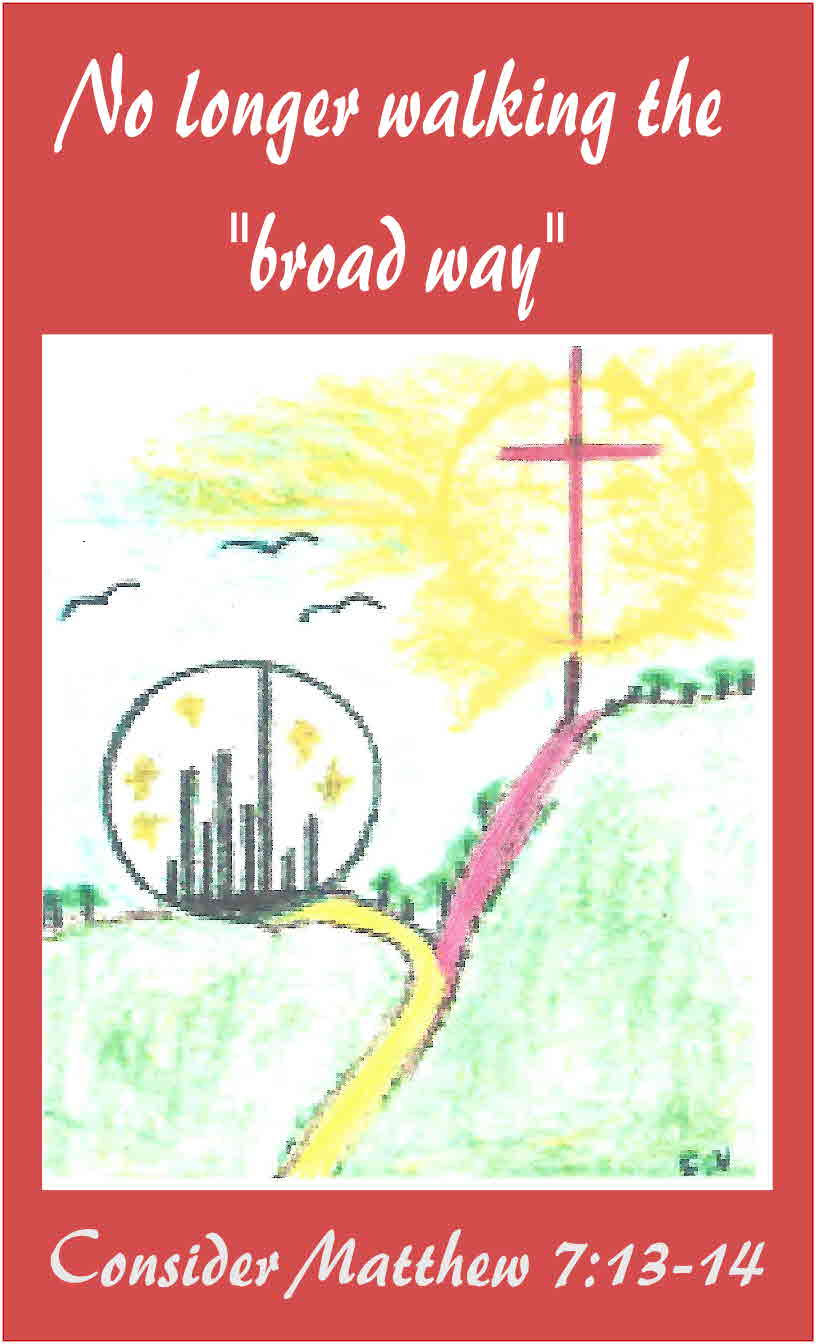
No More Walking the "broad way"

What we can learn from ‘The Wizard of Oz’


Considering Matthew 7:13-14


For sure many of us have seen the movie The Wizard of Oz; I for one have, just about every year of my earlier years – a popular film it was (and still is I imagine). It has been aired on television once a year for many years, and it is probably still available at public libraries and online. 


But what can we learn from that film? It’s about a girl named Dorothy; experiencing a tornado somewhere in the state of Kansas, the house with her in it is then slammed down somewhere in “Munchkin Land.” There she meets the Munchkin people – a friendly and hospitable short people. But she remembers her home is in Kansas and wishes to get back there, to her aunt and uncle. 


The Munchkins inform her that she should go to the “Emerald City” and meet the wizard of Oz; as she is encouraged he can help her get back to Kansas. To get to the Emerald City, however, she has to follow the yellow brick road, as the “good witch” instructs her and puts on her feet a pair of ruby slippers. But the way is not easy, for one the “bad witch” pursues her, attempting to get those ruby slippers.

And so Dorothy is off following the yellow brick road on her way to the Emerald City to meet the wizard of Oz with hopes she’ll find her way back to Kansas. On her way down that road, she meets three others -- a scarecrow, who needs a brain, a tin man who needs a heart, and a cowardly lion who needs courage. And so, they continue on together, following that "yellow brick road" to meet the wizard of Oz.


But, there is something else some of us may have missed in viewing that movie. Myself seeing the film, I noticed as Dorothy was still in Munchkin Land there was another road – a red brick road – running parallel to that yellow brick road; in my mind, I asked for some reason (wondering) where does that red brick road go?


The film brings one to realize the evil along with the good – “good” witches and bad witches (uh, is there truly any such thing as a “good” witch?) – wizards, warlocks, vampires, and psychics. Along with astrologers and sorcerers; all is evil – up to no “good” in God’s eyes. But then there’s the Emerald City to cover up it all, emphasizing the earthly pleasurable pursuits.


Something more pleasurable, however, as I have come to realize is pursuing the immortal things of God in my walk along this mortal narrow way (consider Matthew 7:13-14). Like Dorothy, I too have three friends walking along with me – the Almighty Three-in-one Elohim, my “brain,” my heart,” and my “courage.” (As with all of us, “fearfully and wonderfully made,” see Psalm 139:13-15).


As my “brain,” as God encourages in His Word, I’m to seek wisdom, and He is my wisdom all along the way.

...for wisdom is better than jewels, and all that you may desire cannot compare with her. I, wisdom, dwell with prudence, and I find knowledge and discretion.,” Proverbs 8:11-12.

...for I will give you a mouth and wisdom, which none of your adversaries will be able to withstand or contradict,” Luke 21:15.

“…whatever is true, whatever is honorable, whatever is just, whatever is pure, whatever is lovely, whatever is commendable, if there is any excellence, if there is anything worthy of praise, think about these things,” Philippians 4:8.


As my “heart,” from all my idols, I am cleansed (see Ezekiel 36:25).

God says, I will give you a new heart, and a new spirit I will put within you. And I will remove the heart of stone from your flesh and give you a heart of flesh.27 And I will put my Spirit within you, and cause you to walk in my statutes and be careful to obey my rules,” Ezekiel 36:26, 27.

“And you show that you are a letter from Christ delivered by us, written not with ink but with the Spirit of the living God, not on tablets of stone but on tablets of human hearts,” 2 Corinthians 3:3.


 As my “courage,” God continually reminds me, “Have I not commanded you? Be strong and courageous. Do not be frightened, and do not be dismayed, for the Lord your God is with you wherever you go,” Joshua 1:9; in so going His grace is “all-sufficient (see 2 Corinthians 12:9, as well Exodus 4:12).


Therefore, choosing no longer to follow that "yellow brick road" (the "broad way", see Matthew 7:13-14) to find my way home, having accepted Jesus (Yeshua) -- John 1:12-13 -- I have put off (for the most part) the TV, the Hollywood craves, and sports fanaticism -- my idols growing up. Thinking of this, consider Psalm 24:1-10 and 1 John 2:17. The Life Application Study Bible (LASB) notes, “Because the earth is the LORD’s, all of us are stewards, or caretakers, of it … We are not to become devoted to anything created or act as sole proprietors, however, because the world is passing away (1 John 2:17).

The LASB further notes on 1 John 2:17, “When the desire for possessions and sinful pleasures feels so intense, we probably doubt that these objects of desire will all one day pass away. It may be even more difficult to believe that the person who does the will of God will live forever… Knowing that this evil world will end can give [us] the courage to deny [ourselves] temporary pleasures in this world in order to enjoy what God has promised for eternity.”


Ah, I guess something “good” can from Hollywood after all, at least in this one instance; seeing that red brick road, God used it to remind me of the more meaningful way – through the blood of Jesus (Yeshua), the Christ (Messiah) – see Colossians 1:19-21 – I have been cleansed and given a new more purposeful life. Realizing this for myself, I have, therefore, refocused, traveling the red brick road, serving the immortal in this mortal time, on my way to my forever home, not the fiction “emerald city,” but the eternal Kingdom of God.


Consider also, among others, James 1:5; Colossians 3:16; Ephesians 1:17; Proverbs 1:7; Psalm 27:1; 56:3-4; Isaiah 41:10-13; Matthew 10:28; 1 Corinthians 16:13; Philippians 1:12-14; Hebrews 13:5-6; Deuteronomy 31:6; 2 Timothy 1:7; 1 John 4:18; 1 Chronicles 28:20.